Contextualizing CLIMATE CHANGE

The Earth is billions of years old. Over the long period of Earth's existence there have been many climatic shifts ranging from a constantly volcanic planet to numerous ice ages. Believe it or not the Earth has been through much worse than the current climate we have now. But why is it still a worry. How does human-influence change the grand scheme of things?
  • Home
  • Why Help The Environment
    • Contextualizing Climate Change
    • Common Environmental Misconceptions
  • The Health Sector and the Environment
    • COVID-19 On The Environment
  • Global Environmental Concerns
    • Major environmental issues of nc
    • Current Environmental Innovations
    • Environmental Justice
  • Action For The Environment
  • About Sheel
  • Support
A Brief History of Ancient Earth's Climate:
Present-day Earth is experiencing increasingly extreme climatic shifts. However, in the grand scope of Earth’s history, climate extremes are nothing new. Our planet has undergone dramatic changes, ranging from conditions hot enough to rival Venus to periods when the entire surface was frozen in a “Snowball Earth” state.

Earth’s shifting climate can be traced back to its formation, which likely resulted from a massive collision between two planetary bodies. In its earliest state, Earth’s surface was composed almost entirely of molten lava. Scientists estimate that surface temperatures reached approximately 2,300 Kelvin (about 3,680°F), making the planet completely inhospitable to life (NOAA Climate.gov). Although Earth was steadily losing heat to space, this raises an important question: how did life eventually arise?

As Earth cooled over time, conditions became favorable for the formation of stable molecules beneath a thick, hydrogen-rich atmosphere. One of the most significant milestones in the history of life occurred around 2.4 billion years ago with the emergence of cyanobacteria. These organisms used photosynthesis to convert sunlight, carbon dioxide, and water into energy, releasing oxygen as a byproduct. The rapid accumulation of oxygen in the atmosphere is known as the Great Oxidation Event.

Although oxygen levels eventually stabilized, this transformation fundamentally altered Earth’s environment. The presence of oxygen enabled the evolution of more complex life forms, including multicellular organisms. Multicellular organisms are composed of many specialized cells, each containing organelles that perform distinct functions (National Museum of Natural History). According to the endosymbiotic theory, certain organelles—most notably mitochondria—originated when early eukaryotic cells engulfed free-living bacteria. This symbiotic relationship allowed cells to produce energy more efficiently, laying the foundation for complex life (ScienceDirect).

As oxygen levels increased and multicellular life evolved, Earth became increasingly hospitable. The first animals are believed to have appeared around 800 million years ago. By 580 million years ago, during the Ediacaran Period, animal diversity expanded significantly in Earth’s oceans. Around 541 million years ago, the End-Ediacaran Extinction marked one of the earliest major extinction events, likely driven by environmental change. While some organisms declined, others adapted and thrived (National Museum of Natural History).

​Although extinction events can seem catastrophic, they have played a critical role in shaping the diversity of life on Earth. The End-Ediacaran Extinction paved the way for the emergence of new organisms. Shortly afterward, life diversified at an unprecedented rate during a period known as the Cambrian Explosion, giving rise to many of the major animal groups that still exist today (National Museum of Natural History).

                                                      Proxies

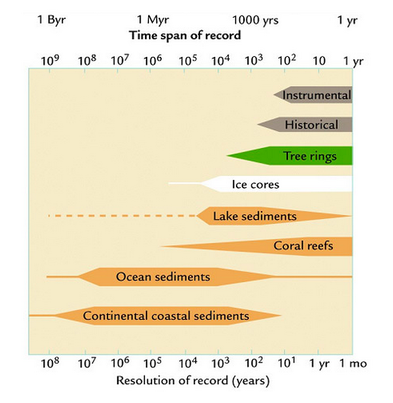
But how exactly have the Earth's environmental trends been documented over this much time? Different types of proxies can document these climatic changes over time. Proxy data are preserved physical characteristics of the environment that can stand in for direct measurements (NOAA).

Picture
The primary proxies, as can be seen my the chart above, used for ancient environmental changes have been sediments. Knowledge for the precambrian period and the advent of multicellular life have been documented through imprints or changes in proxies. For more recent environmental data tree rings, ice cores, and even instrumental records can be used to have an inference about past climates. Other types of proxies are also used including diatoms and even pollen grains. Proxies are critical to understanding the past climate of the Earth and has allowed us to document Earth's turbulent history.
Historic Climate Shifts
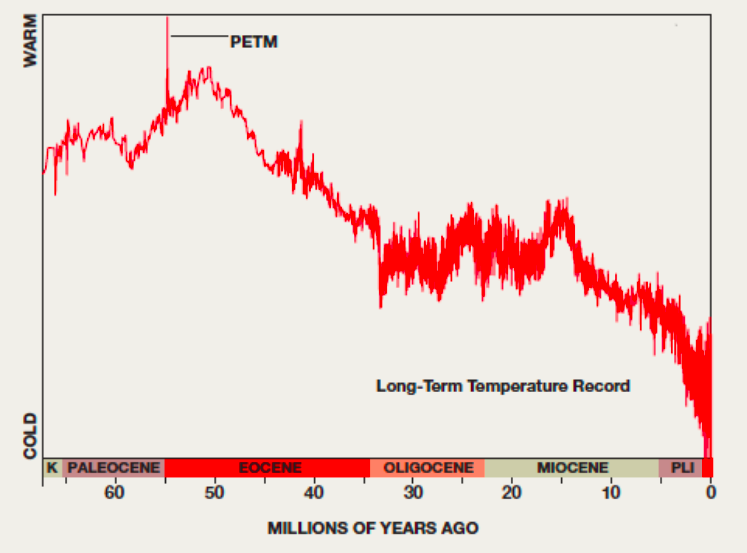
Studies done by paleontologists and analysis of proxies have allowed humans to understand the many changes Earth has undergone. Unprecedented changes in temperature, composition, and life on Earth are just some of these shifts. The Paleocene Thermal Maximum (PETM) was one the first, extremely rapid shifts in Earth's climate. Only over a period of 10,000 years, it impacted the existing biodiversity greatly. The change in temperature can be seen on the graph below.
Picture
However, this thermal maximum still occurred over a period of 10,000 years - modern humans have also only been around for around 10,000 years. The exact causes of the PETM cannot be pinpointed. Potential causes include gas hydrates in marine sedimentary rocks, permafrost melt releasing methane, and even volcanic activity. Still, much of the modern anthropogenic climate climate has started from the Industrial Revolution - in the 18th and 19th centuries. Human potential to contribute to climate change is unprecedented and at a geologic scale, our impacts on the climate are much greater than any natural cause.

Events such as the PETM led to the extinction of certain species and the rise to new species. A better known extinction event includes the Cretaceous-Paleogene extinction event, the extinction of the dinosaurs. This happened about 66 million years ago when a asteroid collided with the Earth sending ash and other debris into the atmosphere (NPS.gov). The Cretaceous-Paleogene extinction event was sudden, occurred over days, leading to about 75 percent of all species going extinct.
Snowball Earth
Although proxies and other scientific tools have been used to clear up misconceptions on the past history of Earth, there are still many uncertainties. Scientific data has shown multiple trends - from scorching hot climates to ice ages - that have temporarily characterized Earth's climate. A major hypothesis that has been agreed on by multiple scientists is that of snowball Earth. This hypothesis proposes that during one of the world's ice periods, the planet's surface was almost completely frozen. But how exactly did this hypothesis come about? Scientists predict that this phenomenon occurred because of ice-albedo feedback loops. The hypothesis involved that as the amount of sunlight reaching the Earth decreased, the ice expanded from the poles to the equator. Ice has a higher reflectivity and as a result the hypothesis presumed that this feedback loop eventually led to a nearly entirely frozen Earth.
 
Key Takeaways
Specific Examples:
  • During the Permian-Triassic extinction event, also known as the "Great Dying," about 252 million years ago, over 90% of marine species and 70% of terrestrial species went extinct due to a massive release of carbon from volcanic activity and other sources, leading to a rapid warming of the planet.
  • The Paleocene-Eocene Thermal Maximum, around 56 million years ago, was a period of rapid warming that caused the extinction of many deep-sea organisms and the proliferation of tropical species in what is now the Arctic.
  • Around 6 million years ago, the Mediterranean Sea evaporated completely during a period of intense drying and warming known as the Messinian Salinity Crisis.
  • During the last ice age, which peaked around 20,000 years ago, ice sheets covered large parts of North America, Europe and Asia. Sea levels were about 120 meters lower than today.
  • The Younger Dryas, around 12,800 years ago, was a sudden return to near-glacial conditions that lasted for about 1300 years, during which time much of the northern hemisphere experienced a return to colder, drier conditions.

General:
  • Earth's climate has changed over time, with periods of warming and cooling. Currently, we are experiencing an extensive period of warming.
  • The Earth has experienced multiple ice ages, as well as warmer periods in between.
  • The current warming trend is largely caused by human activities, specifically the burning of fossil fuels which releases greenhouse gases into the atmosphere
  • This warming is causing the polar ice caps to melt, sea levels to rise, and more extreme weather events to occur.
  • It is important for humanity to reduce greenhouse gas emissions in order to slow and ultimately stop the warming trend
  • Earth's atmosphere has increasing unpredictability; trends have become harder to follow over time
Proudly powered by Weebly
  • Home
  • Why Help The Environment
    • Contextualizing Climate Change
    • Common Environmental Misconceptions
  • The Health Sector and the Environment
    • COVID-19 On The Environment
  • Global Environmental Concerns
    • Major environmental issues of nc
    • Current Environmental Innovations
    • Environmental Justice
  • Action For The Environment
  • About Sheel
  • Support